Slovensko

The arms of the Counts of Celje: three gold six-pointed stars on blue

The House of Celje · 1341–1456

Grofica

Three countesses of Celje. An empress, a woman the family would not forgive, and a Serbian princess who outlived them all.

Prologue

The house with three stars

On 16 April 1341, in Munich, Emperor Louis the Bavarian made Friderik of Žovnek, of a family of minor nobles from the Savinja valley, and his heirs Counts of Celje. Within a century they were one of the most powerful families in Central Europe, and in 1436 they were made Princes of the Holy Roman Empire. Twenty years later the male line was gone, and their lands passed to the Habsburgs.

Their arms, three gold stars on blue, came to them in 1322 from the Counts of Heunburg, when that family died out and Friderik, the last count's nephew, was among the heirs. This is the story of three women who married into that rise and fall, or were born into it.

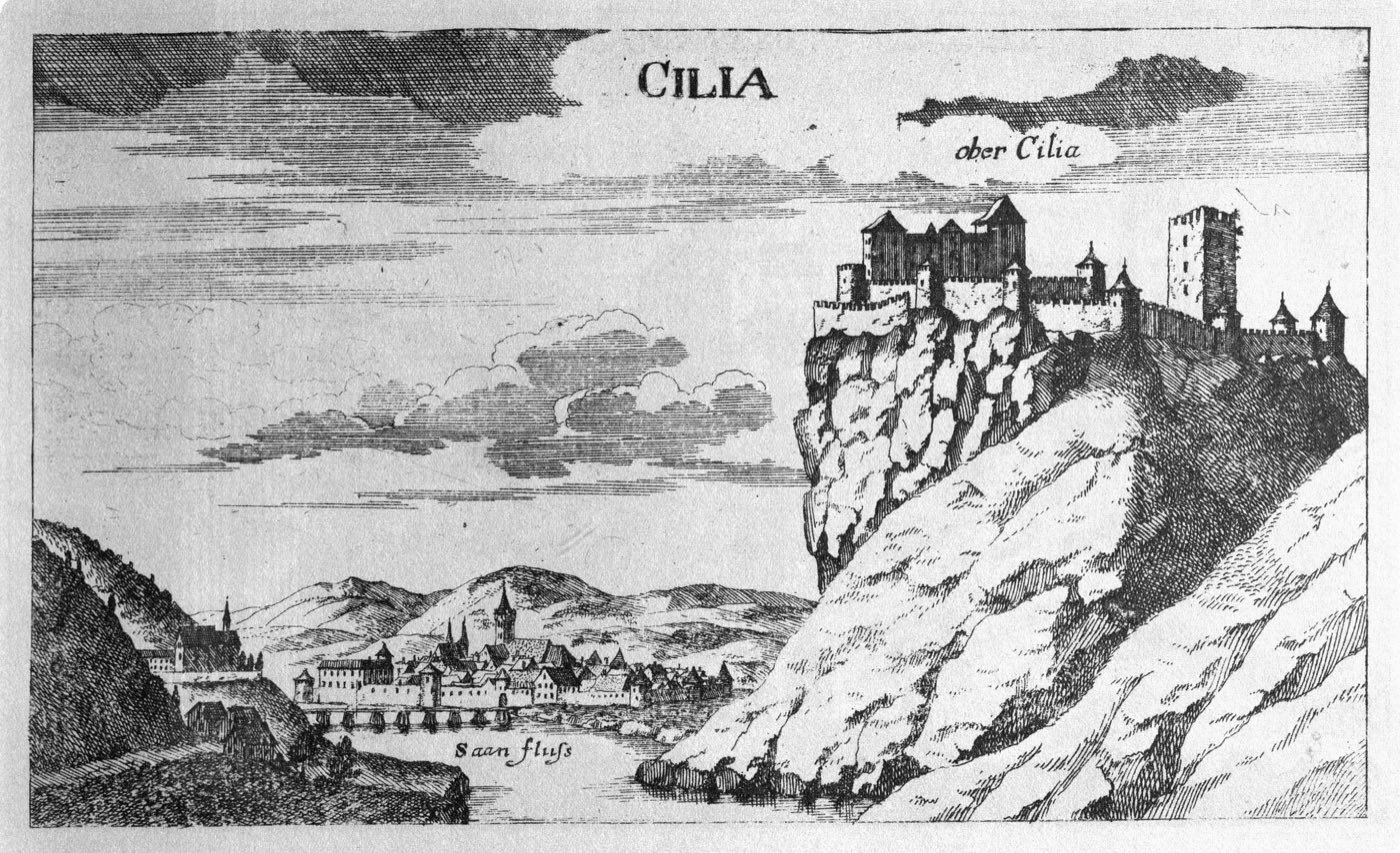
Copper engraving: the walled town of Celje on a river, a bridge, and a large castle on a steep rock above it.
Celje, with the Old Castle (ober Cilia) on the rock and the Savinja (Saan fluss) below. Georg Matthäus Vischer, Topographia Ducatus Stiriae, 1681.

The years

  1. 1341Friderik of Žovnek becomes Count of Celje
  2. 1405Barbara marries Sigismund and is crowned Queen of Hungary
  3. 1408Barbara and Sigismund found the Order of the Dragon
  4. 1414Barbara is crowned Queen of Germany at Aachen
  5. 1425Veronika is drowned at Ojstrica (or 1428)
  6. 1434Katarina marries Ulrich II
  7. 1436The counts become Princes of the Empire
  8. 1437Barbara is crowned Queen of Bohemia in Prague
  9. 1451Barbara dies of plague at Mělník
  10. 1456Ulrich II is killed at Belgrade on 9 November; the line ends
  11. 1492Katarina dies, the last of them
  12. 1921The stars stand for Slovenes in the arms of the Kingdom of Serbs, Croats and Slovenes
  13. 1991The three stars go onto the arms of Slovenia

Act I

The Empress

Barbara was a daughter of Herman II, Count of Celje. In 1401 her father betrothed her to Sigismund of Luxembourg, King of Hungary, twenty-four years her senior. They married at Krapina in November 1405, when she was about thirteen, and in December she was crowned Queen of Hungary.

Sigismund collected crowns, and Barbara rose with him. In 1414 she was crowned Queen of Germany at Aachen, the last queen crowned in Charlemagne's old capital, and in 1437 Queen of Bohemia, in St Vitus Cathedral in Prague. The documents often call her empress, but she was never crowned one.

She was one of the richest women in Europe and ran her vast estates herself; at least 270 of her charters survive. In 1408 she and Sigismund founded the Order of the Dragon, the knightly order that later gave Vlad II of Wallachia his name, Dracul.

Her enemies wrote her reputation. The emperor's chancellor, Caspar Schlick, hated her, and the humanist Aeneas Silvius Piccolomini, later Pope Pius II, spread his version across Europe: until the 20th century historians called her the “German Messalina”. Only in recent decades has she been rehabilitated.

When Sigismund died in 1437, his successor Albert had her imprisoned in Bratislava. In 1438 she fled to the Polish court in Kraków with five hundred horsemen and her treasury, and in 1441 she returned to Bohemia, to Mělník, where she died of plague on 11 July 1451. She was buried in St Vitus Cathedral in Prague; exactly where is no longer known.

She was also Friderik's sister, which matters in the next act.
Act II

The Outsider

According to the Celje Chronicle, Veronika was of knightly birth, well below the counts. Her name has long been linked to Desinić in the Croatian Zagorje, but only because the names sound alike; where she came from is still unknown.

Friderik II, Herman's son, had lived apart from his first wife, Elizabeth Frankopan, since about 1415. She died, probably in 1423; the story that he stabbed her in her bed does not fit the sources. By the middle of 1425 Friderik had married Veronika, and they lived at Fridrihštajn, a castle above Kočevje.

Herman would not accept a daughter-in-law of such low birth, and neither would his son-in-law, Emperor Sigismund. Sigismund had Friderik arrested and handed him to his father, who threw his own son into prison. Veronika fled to Friderik of Ptuj, who hid her at Vurberg, but Herman's men found her.

Herman put her on trial in Celje as a witch, accused of driving Friderik mad with sorcery and of trying to poison Herman himself. Her advocate argued so well that the court refused to convict. Herman had her locked up at Ojstrica anyway, and on 17 October 1425 (1428, by some sources) had her drowned in a tub.

She was buried at Braslovče. Later Friderik had her moved to the Carthusian monastery of Jurklošter, where every year on 17 October prayers were said for her. Their story has been retold ever since, in plays, novels and an opera; Oton Župančič made it a verse drama, Veronika Deseniška, in 1924.

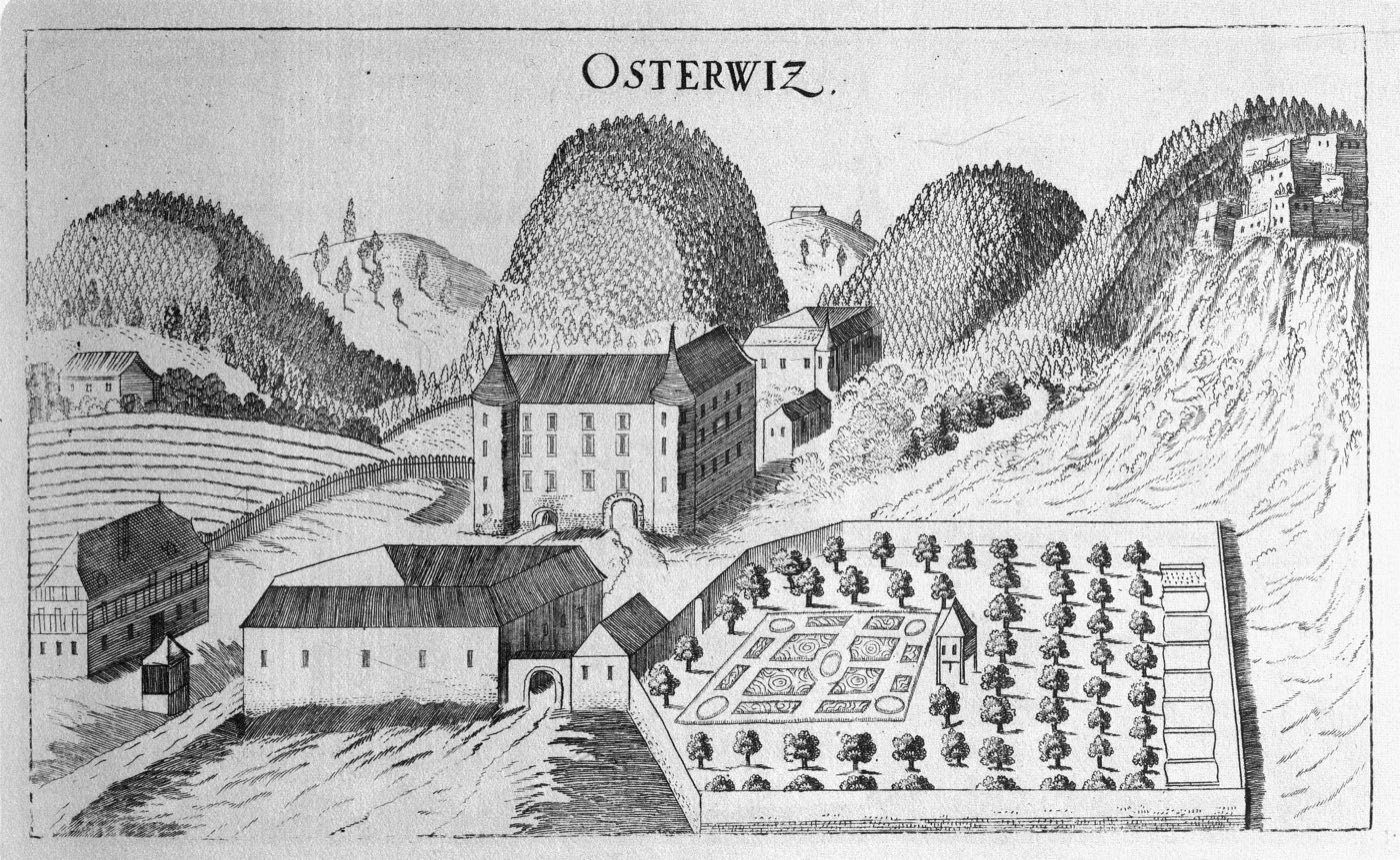
Copper engraving: a manor house with a walled formal garden in a wooded valley, and a castle on the hill above, top right.
Ojstrica (Osterwiz) as Vischer drew it in 1681, more than two and a half centuries after Veronika was held here. Georg Matthäus Vischer, Topographia Ducatus Stiriae, 1681.

Act III

The Survivor

Katarina was a Serbian princess, the daughter of Despot Đurađ Branković and the Byzantine princess Irene Kantakouzene, which is why she is also called Kantakuzina. On 20 April 1434, at fifteen, she married Ulrich II, Friderik's son, a match that tied the Serbian despots to one of the great houses of Central Europe.

Ulrich became the most powerful man the house ever produced: from 1452 guardian of the young King Ladislaus and ruler of Austria in all but name, in 1456 royal governor of Hungary. That November he came with the king to Belgrade, where an army was gathering against the Ottomans. On the morning of 9 November, in the fortress, László Hunyadi's men attacked him and cut off his head.

He was the last Count of Celje, and he left no son. Twenty-three claimants fought over the inheritance; in 1457 a court in Graz gave all of it to the Habsburg emperor Frederick III. Katarina, for whom three scribes had copied a Serbian church book, the Varaždin Apostle, in 1454, outlived her husband by thirty-six years and died in 1492.

Epilogue

The stars outlasted them

The counts lasted 115 years; their stars have lasted longer. Eighteen of the counts' skulls, from Friderik I to Ulrich II, survived in the Minorite monastery in Celje. From 1921 the stars stood for Slovenes in the arms of the Kingdom of Serbs, Croats and Slovenes, and when Slovenia adopted its own coat of arms in 1991, it set three gold six-pointed stars above Triglav.